
5 Hidden Costs of Traditional Print Management and How to Beat Them

Marcus Varner
June 18, 2026
8 mins
Years into the push toward digital transformation, companies have made significant headway in digitizing most aspects of their business. But print remains a stubborn holdout and is actually on the rise in many common use cases. According to IDC’s 2025 Document Process Survey, the printing of emails, reports, documents that require signatures, and spreadsheets actually rose between 2022 and 2025.1
No wonder, then, so many companies find themselves unable to digitally transform their print processes. Unfortunately, this means that traditional print management’s inherent inefficiencies and costs also continue to linger in these organizations.
Instead of illuminating opportunities to streamline workflows or determine who is using how much of what, traditional print management continues to obscure the data and make it easy for costs to grow out of control.
“With traditional print management and its outdated infrastructure, you pay more than you should and you may not even see it,” remarked Devin Payne, product marketing director at Vasion on a recent Vasion podcast episode. “If you're a large organization, with more and more employees, infrastructure, and time wasted, that cost just gets amplified over and over again.”
Loading...
5 Sources of Out of Control Costs in Traditional Print Management
Going beyond dollars to include real vulnerabilities and risks for the business, these traditional print management costs typically spring from one of the following five sources.
1. Print Servers
In traditional print management where businesses rely on physical, on-premise print servers to manage queues, their environments become increasingly unscalable, complex, and hard to maintain.
“Most businesses’ environments are still on legacy infrastructure,” Devin explained. “That's print servers. That's a climate-controlled room for each print server. That’s hiring people to manage those server rooms.”
As these environments become more complex, costs rise in terms of maintenance, the physical space the servers occupy, the energy to power them, and the IT personnel to manage them.
Any time a new printer or user is introduced, it falls to the IT team to manually install drivers and configure queues on the physical server—a process that is anything but scalable. As if this were not a large enough burden for IT, they must also manage driver compatibility, printer mapping, security for all the different locations, and server maintenance. Too often, these ongoing IT resource- and hardware maintenance-related costs remain invisible to the organization.
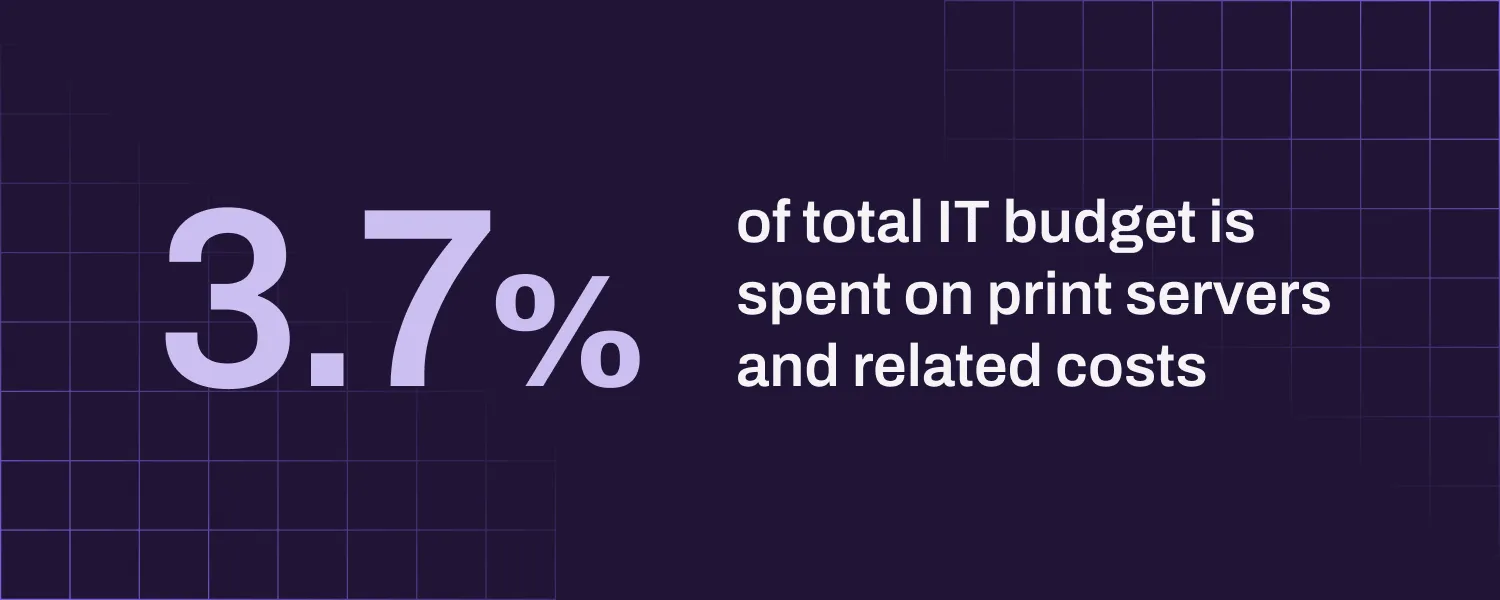
Ultimately, these costs add up to figures that have a real negative impact on companies’ bottom lines. For example, in organizations with 1,000-plus employees, the annual cost of acquiring and managing print servers reaches an average of $222,900.2 IDC research shows that, on average, organizations spend 3.7% of the overall IT budget on print servers and related costs.3
2. Multiple Systems, Multiple Vendors
In traditional print management, organizations tend to inadvertently accumulate a mixture of hardware brands and varying, disparate management software platforms. For each printer brand, this essentially creates a different ecosystem that requires its own user interfaces, drivers, and support contracts. More importantly, it makes standardization and centralized control across all printers virtually impossible.
This prevents organizations from getting their arms around their most fundamental metrics, like total print costs, or properly enforcing policies to manage printing behaviors. From there, costs quickly get out of control. Actual printing expenses increase and toner and paper costs rise, but organizations lack the data to identify the source of these issues, much less correct the problem.
This lack of visibility becomes especially risky for organizations when it comes to print-related regulatory and compliance issues. In industries where organizations are supposed to maintain printed versions of certain critical documents to provide to auditors and regulators, those with decentralized print environments run the risk of costly fines and heavy penalties.
For example, failure to comply with GDPR regulations in the European Union can result in fines to the tune of tens of millions of euros. HIPAA fines in the U.S. can set a company back hundreds of thousands of dollars, while fines in the financial services industry have been known to reach tens of millions of dollars.
3. Limited Security
One of the biggest vulnerabilities posed by traditional print management can be found in the printer tray. Lacking any kind of user authentication, as soon as the user clicks ‘print’, the document goes directly to a printer to be produced, whether or not the user is present at the machine to ensure that the document’s contents are treated with proper discretion.
Too often, copies of confidential materials—think financial data or medical records—can sit fully exposed in a printer tray for an extended period of time. In the meantime, passersby can view this sensitive information or even swipe the entire document for themselves.
In addition, traditional print management’s reliance on multiple systems and vendors makes it difficult for organizations to track who is printing sensitive files or when. This, in turn, stymies the organization’s ability to detect, investigate, or prevent insider data leaks.
Finally, traditional print management setups are more prone to attacks via vulnerabilities like PrintNightmare, which allowed attackers to remotely execute code and enabled unauthorized users to take full control of systems. Print servers are a major attack surface, best mitigated by getting rid of them altogether.
The consequences of such data leaks, breaches, and attacks can range from minor operational hiccups to catastrophic business failure, including significant reputational damage and identity theft for individuals. Immediate financial loss is also a major risk: IDC's research indicates that the average cost of a print-related security breach is $658,000.4

Perhaps even more devastating is the long-term costs that result from the customer attrition, operational downtime, and loss of competitive advantage that such security breaches can bring.
4. IT Team Supervision
Few teams feel the cost of traditional print management as much as IT does. Between jams, driver errors, and connectivity problems, these teams are hit by a constant barrage of printer-related help desk tickets.
Combine that with the time these teams must devote to managing inconsistent drivers across different printer brands and operating systems and installing, patching, and managing print servers, and IT teams have little to no time to focus on the strategic initiatives that would actually allow their operations to run more effectively or reduce costs.
Ultimately, with traditional print management organizations pay more and more for IT support overhead, only to find themselves with more reactive fixes, burnout, and backlogs.
5. Combination of Print and Digital
While digital transformation has easily, naturally transitioned so much analog media into a digital equivalent, printed documents have resisted this transition. Individuals and organizations hold tight to printing certain documents in certain cases.
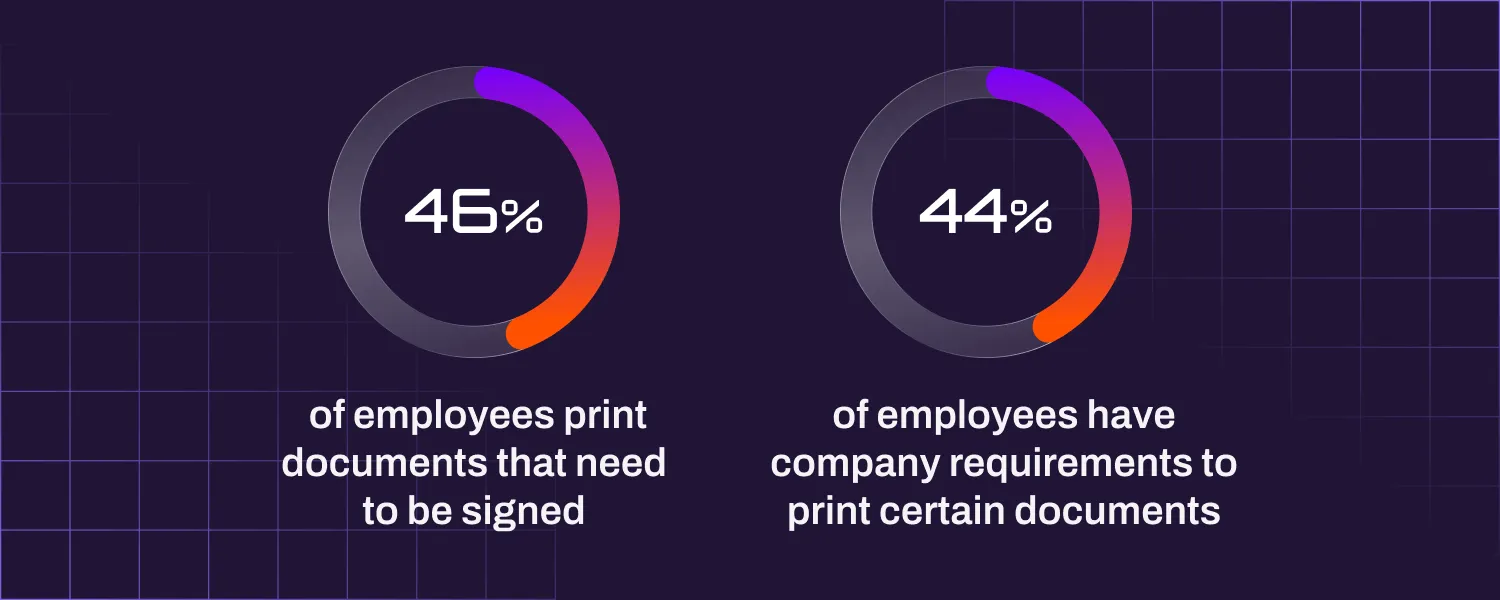
One of these cases is signing documents. The aforementioned 2025 Document Process Survey from IDC found that over 46% of respondents still print documents with the express purpose of getting them physically signed; nearly 44% are required to do so by their company.5
Whether it’s printing emails and spreadsheets for the sake of record-keeping or printing reports to suit the preferences of a director or executive, these practices are ingrained in the way companies do business.
“Print is still very much a needed thing in many, many industries, and we're not going to get away from that overnight,” Devin observed. “This means we have physical processes, and we have digital processes. Physical and digital documents are living together in most organizations.”
However, these parallel approaches prevent companies from getting a complete picture of how documents are circulating through operations. “Typically, the physical and digital processes are separated,” Devin continued. “They don’t share information between each other.”
This creates gaps in visibility that make it easy for costs to persist and grow out of control. Each hard copy printed creates a potential hole in the organization’s understanding of the document’s journey. This makes it hard to build the kind of powerful, automated workflows that could drive greater efficiency within the business.
Thankfully, none of the traditional print management costs listed above is a foregone conclusion or unsolvable. By adopting new approaches and applying new, commonsense technologies to print operations, organizations can slash the costs of traditional print management and reap the benefits of digital transformation.
3 Steps to Eliminating the Costs of Traditional Print Management
To overcome the cost-driving factors mentioned above, Devin and the team at Vasion recommend that companies adopt three strategies.
1. Eliminate Print Infrastructure
“If you want to have the benefits of digital transformation in your printing operations, your print hardware has to go,” said Devin. “It's not enough to just modernize it to make it prettier or faster. It has to be scalable. It has to be flexible. It has to be ready for AI. It has to be ready for the world that we're in.”
He continued, “Once you get rid of all that infrastructure, it opens you up to be remote, to be automated, to drive efficiency in your business to scale.”
2. Consolidate Print Environments
“Companies will have system print, employee print, guest print, and label print, and they’re often used on different softwares,” Devin explained. “Consolidating all of that into one visible place allows you to optimize where you're printing and who's printing and identify opportunities for digital in your journey.”
Devin urged organizations to keep this single platform agnostic. “A big part of modernization is being completely agnostic with your operating systems, your manufacturers, and your IdP providers. This way, no matter who it is, no matter what company comes in, your whole environment can be used on a single platform and you're not stuck to a single manufacturer or operating system.”
3. Automate Print
With print infrastructure eliminated and software consolidated, Devin recommends that businesses leverage AI and other intelligent automation approaches to streamline and improve their ability to track documents and access the data within them.
He explained, “The world is moving too fast for us to print out 500 documents, rearrange them in the right order, get the wet signatures, scan them back in, go back to our email, and store them ourselves.”
“If I print something, it should also auto save into an archive,” he continued. “It should extract the digital data and put it somewhere so I can search it. It should be able to determine what the document is and save it in the appropriate place.”
This kind of intelligent print automation, says Devin, could accomplish this task in 10 seconds.
Cut Costs, Enable Greater Efficiency with Intelligent Print Automation
By modernizing print infrastructure with cloud-native automation, consolidating user- and system-generated print, and unifying print and document workflows, Vasions Intelligent Print Automation is allowing their customers to experience measurable improvements to their print processes, while experiencing an average of 200% ROI.
Sources
1 IDC’s Document Process Survey, 2025: What, How, and Why They Print, # US53462525, May 2025
2. Research Excerpt: Businesses Can Realize Significant Cost Savings by Shifting Print to the Cloud, # US53179125, February 2025
3. IDC PlanScape: Print Modernization to Enable an Effective Hybrid Workforce, #US51982024, June 2024
4. IDC PlanScape: Print Modernization to Enable an Effective Hybrid Workforce, #US51982024, June 2024
5. IDC’s Document Process Survey, 2025: What, How, and Why They Print, # US53462525, May 2025
2. Research Excerpt: Businesses Can Realize Significant Cost Savings by Shifting Print to the Cloud, # US53179125, February 2025
3. IDC PlanScape: Print Modernization to Enable an Effective Hybrid Workforce, #US51982024, June 2024
4. IDC PlanScape: Print Modernization to Enable an Effective Hybrid Workforce, #US51982024, June 2024
5. IDC’s Document Process Survey, 2025: What, How, and Why They Print, # US53462525, May 2025