Three Tiers of No-Code AI: From Plug-and-Play to Enterprise Power

Aaron Airmet
April 3, 2026
5 mins
AI Should Work for Everyone
A martial arts instructor recently told me they’d tried AI to build a class outline. It was so bad they never tried again. Mid-rep, I could think of a half-dozen prompting techniques that would’ve helped—but I’ve spent years learning them. That’s not a reasonable expectation for a fitness instructor, a front-desk worker at a clinic, or an office manager juggling vendor invoices.
That gap is the real accessibility problem. It’s not that AI requires technical expertise—it’s that even the “easy” tools assume a fluency most people don’t have and shouldn’t need. The person doing the work shouldn’t need prompt engineering to get value from AI.
The Reality: AI Solutions Fall Short
AI solutions may claim to be no-code and easy to use, but reality tells a different story. There are a few ways in which these claims are exaggerated or outright false.
The technical expertise trap. Vendors love to claim “no coding required” and “anyone can use it” and “deploy in minutes.” What they might mean: no coding, but you’ll still need to understand API endpoints and data structures. “Anyone" means those with a background in system administration. “Deploy in minutes" after weeks of professional services engagement.
The false “no-code.” This shows up in specific ways—requiring technical expressions for configuration, expecting users to write queries for filtering, demanding understanding of confidence thresholds and model tuning, needing prompt engineering expertise, or requiring middleware specialists to make integrations work.
The complexity hidden behind simplicity. This is a bait-and-switch. Simple demos running on perfect scenarios go smoothly. Then reality hits when the solution encounters actual messy business data. The tool works great on textbook examples but fails on your specific use cases. It handles obvious scenarios but gets confused by real-world ambiguity. It promises customization but locks you into rigid templates. And there’s always “just a little technical setup” that actually demands IT involvement.
The integration fantasy. “Seamlessly integrates with your existing systems” too often means “we have an API your developers can use.” The result: middleware requirements, custom scripting, your IT team becoming gatekeepers for every change, workflow silos instead of streamlined processes, and data that doesn’t flow naturally between systems.
The ongoing dependency problem. Some tools require constant vendor support, consultant engagement, or specialized internal resources to maintain. Every change requires technical resources, limiting who can improve processes and slowing how fast the business can adapt.
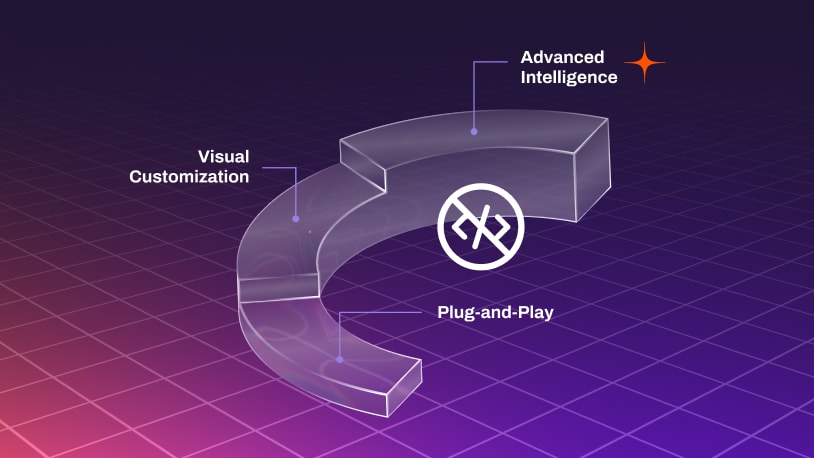
This isn’t to say there aren’t no-code AI solutions. There are. They typically come in three tiers of sophistication that match different comfort levels. From set-it-and-forget-it simplicity to advanced customization, none require any coding. The difference is how much you want to steer.
Tier 1: Plug-and-Play AI—Zero Configuration Required
Technical comfort level: Beginner. If you can click a button, you can use this. Or better yet, if you can speak out loud in natural language, an AI can turn that speech into text and understand what you are trying to say.
Plug-and-play AI is pre-trained and works immediately on common tasks. No setup, no training data, no configuration menus. Turn it on and it works.
This is for the user who wants results now. The team member who needs AI to help with their work but has zero interest in becoming a system administrator.
How it works: The AI arrives already trained on standard business tasks. It recognizes common patterns automatically, makes intelligent decisions without being told what to look for, and routes information based on obvious characteristics. Think of it like spell-check—it’s just there, quietly doing its job.
The value is immediate. You’re getting results within minutes of turning it on. Zero learning curve. No maintenance—improvements happen automatically in the background. It’s a risk-free starting point that delivers value while you figure out what else you need.
Where it shines: Standard workflows, common scenarios, clearly defined tasks, predictable patterns.
Where you’ll outgrow it: Company-specific processes, industry terminology, complex multi-step workflows, tasks that require specialized knowledge, or situations where the way work gets done varies significantly from one instance to the next.
That’s when you move to Tier 2.
Tier 2: Configurable AI—Visual Customization for Your Business
Technical comfort level: Intermediate. You’re the person in the office who builds complex Excel formulas, creates custom email filters, or sets up workflow automation tools. You don’t have coding knowledge, but you’re comfortable clicking through settings and building logic.
Configurable AI lets you teach and customize the system through visual interfaces—clicking, dragging, and pointing rather than coding. You build templates, set rules, and train the system using interface patterns you already know.
Real-world applications at this level get specific to your business: custom approval workflows based on your criteria, content generation using your industry’s terminology, validation rules matching your data standards, automated responses tailored to your scenarios, reports in the formats your team actually uses.
How it works: Visual template builders let you define custom workflows. Point-and-click field mapping connects your data. Drag-and-drop process designers lay out your logic. Rule builders use straightforward “if-this-then-that” patterns. And training by example means you show the system a few instances of what you want and it learns the pattern from there.
The value here is personalization. Your workflows, your terminology, your business logic—automated. The system learns from you and gets smarter as you use it. Start simple and add sophistication when you’re ready.
Where it shines: Organization-specific workflows, industry terminology, custom processes, variable scenarios within your business.
Where you’ll outgrow it: Multi-source analysis requiring complex reasoning, highly contextual decisions, enterprise-scale processing across hundreds of scenarios, data security concerns, or tasks demanding deep AI understanding of nuance.
Tier 3: Advanced AI—Sophisticated Intelligence, Still No Code
Technical comfort level: Advanced, but not technical. You’re the person who documents multi-step procedures, designs business processes, or manages enterprise systems. You’re comfortable with complexity, but not with writing code.
This tier delivers enterprise-grade AI leveraging large language models and contextual reasoning, accessed through intuitive interfaces. The most powerful AI capabilities available, without a single line of code.
The difference here is that instead of the software forcing you to speak “computer,” the software is now understanding you when you simply speak “human.”
How it works: Natural language interfaces let you give complex instructions. Visual process designers handle multi-step workflows. You can literally have a conversation with the AI about what you need—“Analyze these reports and identify trends that deviate from our typical patterns.” Advanced rule engines use plain language logic, and template libraries cover complex enterprise scenarios.
What keeps this genuinely no-code at the enterprise level is conversational AI that understands complex instructions, visual process mapping, pre-built templates you customize, and transparent decisions you can review and adjust through interfaces—not scripts.
The sophistication available is real. Contextual understanding that grasps meaning and nuance. Cross-domain intelligence connecting information across systems. Judgment and reasoning based on context, not just rigid rules. It handles the messy, variable, complicated scenarios your business actually faces—at scale.
The value proposition: Capabilities that typically require data science teams, accessible to process experts. From dozens to millions of instances without changing your approach.
True No-Code Across All Capabilities
The core belief is simple: users shouldn’t have to choose between power and usability. Every tier—from simple to sophisticated—should be genuinely no-code.
The model is progressive capability with a consistent approach. Tier 1 needs no configuration because of its simplicity. Tier 2 offers visual configuration that feels like using familiar software. Tier 3 delivers sophisticated AI controlled through intuitive interfaces. All three share the same philosophy: point, click, drag, describe what you want. The complexity is in what the system can do, not in how you tell it to do it.
The person who understands the business process should be able to implement and optimize the solution. No IT middleman required. No vendor consultants needed. No specialized training programs. AI should amplify expertise, not require it.
Matching Capability to Comfort
Not everyone needs Tier 3 sophistication, and not everyone should be stuck with Tier 1 limitations. True accessibility means offering the right level for each user and each use case.
Whether you want to turn something on and have it work, configure it to match your specific needs, or leverage advanced AI for complex challenges—it should all be genuinely no-code. The right approach meets users where they naturally are and grows with them.