
What CIOs Need to Know About Intelligent Print Automation


Kait Maag
June 8, 2026
8 mins
Your print environment is doing exactly what it was designed to do twenty years ago. That's the problem.
While you've been modernizing every other part of your IT stack, your print infrastructure has stayed exactly where it was, quietly consuming budget, accumulating security risk, and producing documents that exit your digital ecosystem the moment someone clicks print. Nobody made a deliberate choice to leave it behind. Print just never made the priority list, because it worked well enough to stay invisible. And invisible infrastructure is infrastructure your strategy can't touch.
The consequences of that invisibility used to be manageable. They aren't anymore.
Every AI initiative in your organization depends on structured data. Your forecasting tools, your contract analysis platform, your compliance automation, your clinical decision support systems: all of them are reaching for data that exists, in volume, in your document layer. And most of that data is exiting as printed pages, scanned images, and flat PDFs that no model can ingest, routed through infrastructure that predates the cloud and has never been asked to do anything more than get a document to a printer.
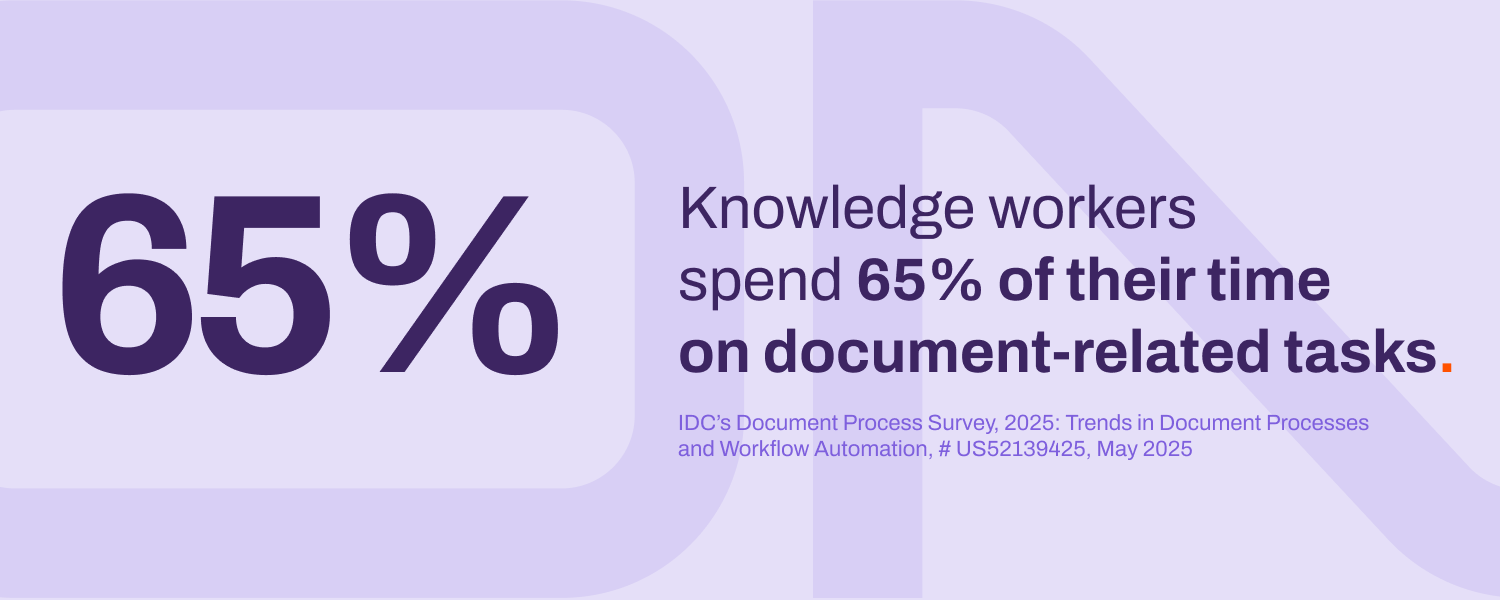
This is the gap that Gartner has been tracking with increasing urgency. IDC reports that knowledge workers spend 65% of their time on document-related tasks (paper and digital)1. According to Gartner®, "roughly 80% of enterprise information is unstructured, spread across documents, files, and rich content in dozens of systems2." Gartner also states that "only 14% of leaders are very confident that their content and data can provide value for AI and human interactions3." And lack of GenAI-ready data is now the top reason for failed AI deployments. The ambition is there. The foundation isn't. And for most organizations, the missing foundation traces directly back to a layer nobody prioritized: the document layer that print controls.
The Problem Nobody Scoped
Most CIOs aren't ignoring print because they don't care. They're ignoring it because nobody connected it to the initiatives they do care about. That changes the moment you trace where your data is actually going.
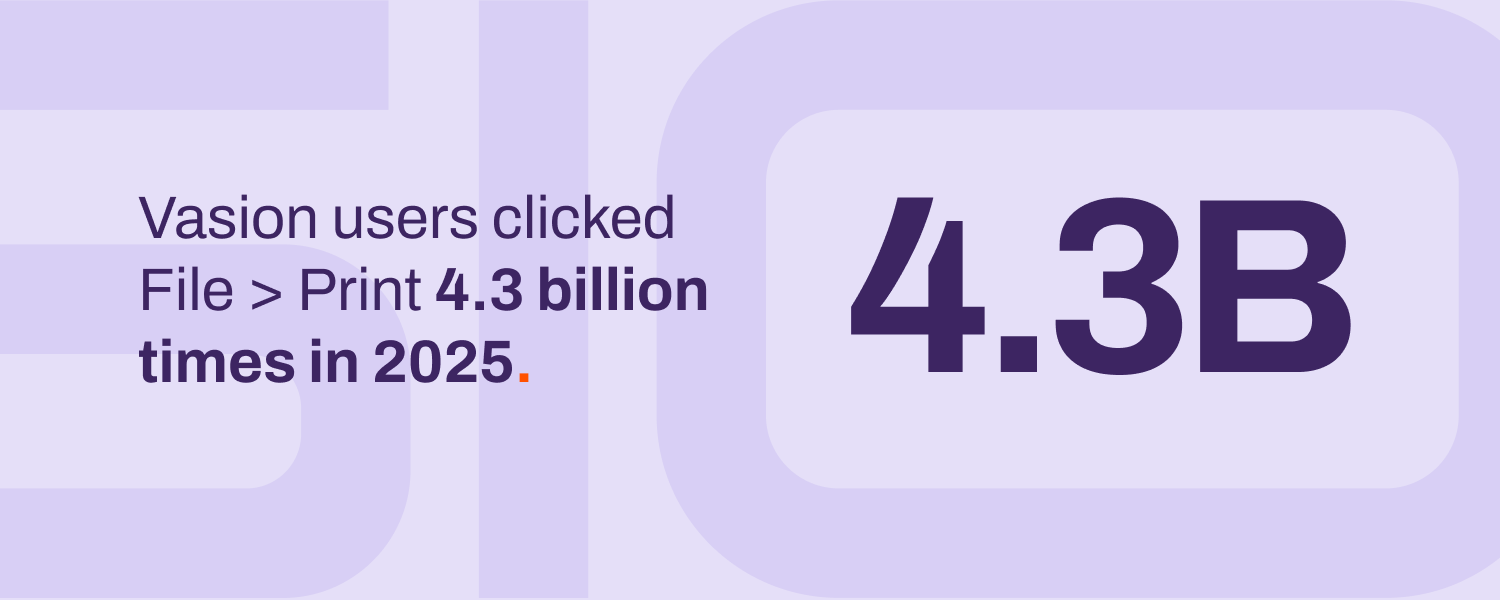
File > Print is the most universal action in computing. It runs on every machine in your organization. Every employee already knows how to use it. And right now, for most organizations, every time someone clicks it, a document exits the digital ecosystem entirely, carrying data that never comes back. In 2025 alone, Vasion users clicked File > Print 4.3 billion times4. For organizations without Intelligent Print Automation, every one of those was a dead end.
That's not a print management problem. That's a data problem, a security problem, and an AI readiness problem that happens to live inside infrastructure everyone assumed was someone else's concern.
The security dimension alone deserves a closer look. Print servers, the on-premise infrastructure most organizations still rely on for end user printing, consume an average of 3.7% of the overall IT budget before IT labor (IDC). They require dedicated hardware, ongoing maintenance, and scripted management that breaks on OS updates and driver changes. And they're attack surfaces: CVE-2021-34527 demonstrated that print servers can deliver admin-level system access. Quocirca's Print Security Landscape, 20255 found that 56% of organizations experienced at least one print-related data loss in the past year. The vulnerability class hasn't closed because the infrastructure hasn't changed.
Then there's the output management problem, which most organizations treat as entirely separate. Critical systems printing from ERP and EHR platforms to produce packing slips, patient wristbands, pharmacy labels, invoices, etc. run on a completely different infrastructure, managed by a different team, in a different console, with a different audit trail. When output fails on a production line at 3:00 am, the ERP admin troubleshoots in one system while the SysAdmin troubleshoots in another, and neither can see what the other is looking at. Two infrastructures, two audit trails, two vendor relationships, and no unified visibility across the document environment. To us, this is the fragmentation that Gartner describes as introducing blind spots, eroding trust, increasing risk, and limiting the potential of AI initiatives.
This is why Gartner reports that, “in the fast-paced world of digital transformation, organizations are grappling with a stark reality: only 48% of digital initiatives succeed globally.”6 Not because the technology is wrong, but because the sequence is wrong. Organizations are investing in transformation above and below the document layer without ever addressing the layer itself.
What Intelligent Print Automation Actually Solves
The market has responded to the document layer problem by selling point solutions. An output management tool. A workflow automation platform. A print management product. Each solves one problem in one silo. None connects to the others. And organizations end up with the same fragmentation they were trying to fix, just with newer software and more vendor relationships to manage.
Intelligent Print Automation is a different kind of argument. It's the argument that you have to build the foundation before the intelligence works, and that the foundation itself is intelligent, and the right sequence is to modernize, then consolidate, then automate.
Modernize is where the sequence starts, because nothing else works until the bottleneck is gone. Eliminating print servers and replacing them with a cloud-native, serverless, direct IP architecture means every document is now visible, every print event is auditable, and the platform is already making intelligent infrastructure decisions from day one. Right printer, right driver, right user, right location, automatically, without a human in the loop. This is where the SysAdmin sees up to 90% fewer print-related helpdesk tickets and stops managing servers entirely. It deploys in days, not months, and fewer than 1% of customers need paid professional services to get there.7

Consolidate is where the cost of fragmentation disappears. End user print and critical systems output on one platform means one console, one audit trail, one security model across every document event in the organization. The ERP admin gets 99.99% uptime and automatic failover on critical output. The compliance team gets a single trail across every document that moves through the organization, rather than assembling audit evidence from four separate systems. And the IT Director stops managing parallel infrastructures that can't see each other.
Automate is where the AI story becomes real. With a modernized, consolidated foundation underneath it, AI classification, extraction, and agentic workflows can activate on every document already flowing through the platform. Documents become structured data. Print events become workflow triggers. The data that was existing as flat files, invisible to every downstream system, starts feeding your AI instead. The 80% of enterprise information that was unstructured starts becoming accessible, from the same File > Print action employees already use.
Security runs underneath all three as the foundation, not a fourth step. Authenticated and auditable at every tier, built for compliance, backed by FedRAMP® High Authorization, ISO 27001:2022, ISO 42001:2023, and SOC 2 Type 2. The CISO doesn't gate this project because the infrastructure is Zero Trust by design from the moment it's deployed.
The sequence matters because you cannot automate what hasn't been consolidated, and you cannot consolidate what hasn't been modernized. Organizations that try to skip steps are the ones buying AI document tools that can't see half their documents, or output management solutions that don't connect to end user print, or modern infrastructure that still produces dead-end data. “In fact, Gartner® predicts that through 2026, organizations will abandon 60% of AI projects unsupported by AI-ready data.”8 That risk is widespread. 63% of organizations either do not have or are unsure whether they have the right data management practices for AI. Poor data quality persists as one of the most frequently cited challenges blocking AI deployment. The investment in AI capability has outpaced the investment in the data infrastructure that capability requires, and the gap shows up most visibly at the document layer.
Organizations are rushing to AI without the foundation underneath it. IPA builds the foundation first.
The On-Ramp Is Already Installed
The most counterintuitive thing about IPA is the adoption story, and it's the thing that separates it from every other transformation initiative on your roadmap.
Every other initiative you're running requires behavior change. New tools, new habits, a change management program, and a timeline measured in quarters before you see ROI. IPA starts where adoption already exists. File > Print is already deployed on every machine in your organization. Every employee already knows how to use it. There is no rollout. There is no training. There is no adoption curve. The same click employees have been making for twenty years now captures, classifies, and routes every document into the workflows, signatures, and structured storage your organization needs.
That's why IPA breaks the pattern that kills 52% of digital initiatives. Adoption isn't a barrier because behavior doesn't change. The click stays the same. Everything after it does more.
The ROI story at modernize is concrete enough to take to the board before the next quarter ends: print servers eliminated, helpdesk tickets down significantly, security posture improved, cloud migration completed. Consolidation and automation build on that same platform, each step delivering value on its own, each step enabling the next.
Where Does Your Organization Sit?
Most organizations are further behind than they realize, because the gap isn't always visible until you trace a document all the way through.
If your team is still managing print servers, GPOs, and driver scripts, that's a modernize problem. If your IT Director is operating separate consoles for end user print and system output, that's a consolidate problem. If your infrastructure is clean but your documents are still flat PDFs your AI tools can't see, that's an automate problem.
The document layer is the one layer nobody has fully activated. It's also the layer that touches every employee, every device, every document in the organization. And the infrastructure to activate it is already deployed on every machine your organization owns.
There is nothing to roll out. There is only something to turn on.
Vasion's Intelligent Print Automation platform covers the full sequence: PrinterLogic for print and output automation, Vasion Automate for agentic automation and document intelligence, on one platform, under one security model, managed from one console.
1. IDC’s Document Process Survey, 2025: Trends in Document Processes and Workflow Automation, # US52139425, May 2025
2. Gartner, Navigating the Solutions Landscape for Managing Documents, Marko Sillanpaa, 26 February 2026
3. Gartner, Top Actions to Drive Success in Building Agentic AI Solutions, Aaron Harrison, Haritha Khandabattu, 9 April 2026
4. Based off internal Vasion customer data, case studies, and reports
5. Quocirca, Print Security Landscape Report, 2025
6. Gartner, Make Tech Culture Go Viral, Mandi Bishop, Daniel Sanchez Reina, September 9, 2025
7. Based off internal Vasion customer data, case studies, and reports
8. Gartner Press Release, Lack of AI-Ready Data Puts AI Projects at Risk, Q& A with Roxanne Edjlali, February 26, 2025
GARTNER is a trademark of Gartner, Inc. and/or its affiliates
2. Gartner, Navigating the Solutions Landscape for Managing Documents, Marko Sillanpaa, 26 February 2026
3. Gartner, Top Actions to Drive Success in Building Agentic AI Solutions, Aaron Harrison, Haritha Khandabattu, 9 April 2026
4. Based off internal Vasion customer data, case studies, and reports
5. Quocirca, Print Security Landscape Report, 2025
6. Gartner, Make Tech Culture Go Viral, Mandi Bishop, Daniel Sanchez Reina, September 9, 2025
7. Based off internal Vasion customer data, case studies, and reports
8. Gartner Press Release, Lack of AI-Ready Data Puts AI Projects at Risk, Q& A with Roxanne Edjlali, February 26, 2025
GARTNER is a trademark of Gartner, Inc. and/or its affiliates