
The Printout Nobody Picked Up: Closing Healthcare's Most Overlooked PHI Leak


Victor Grund, VP Solutions Engineering, Vasion
October 7, 2026
6 mins
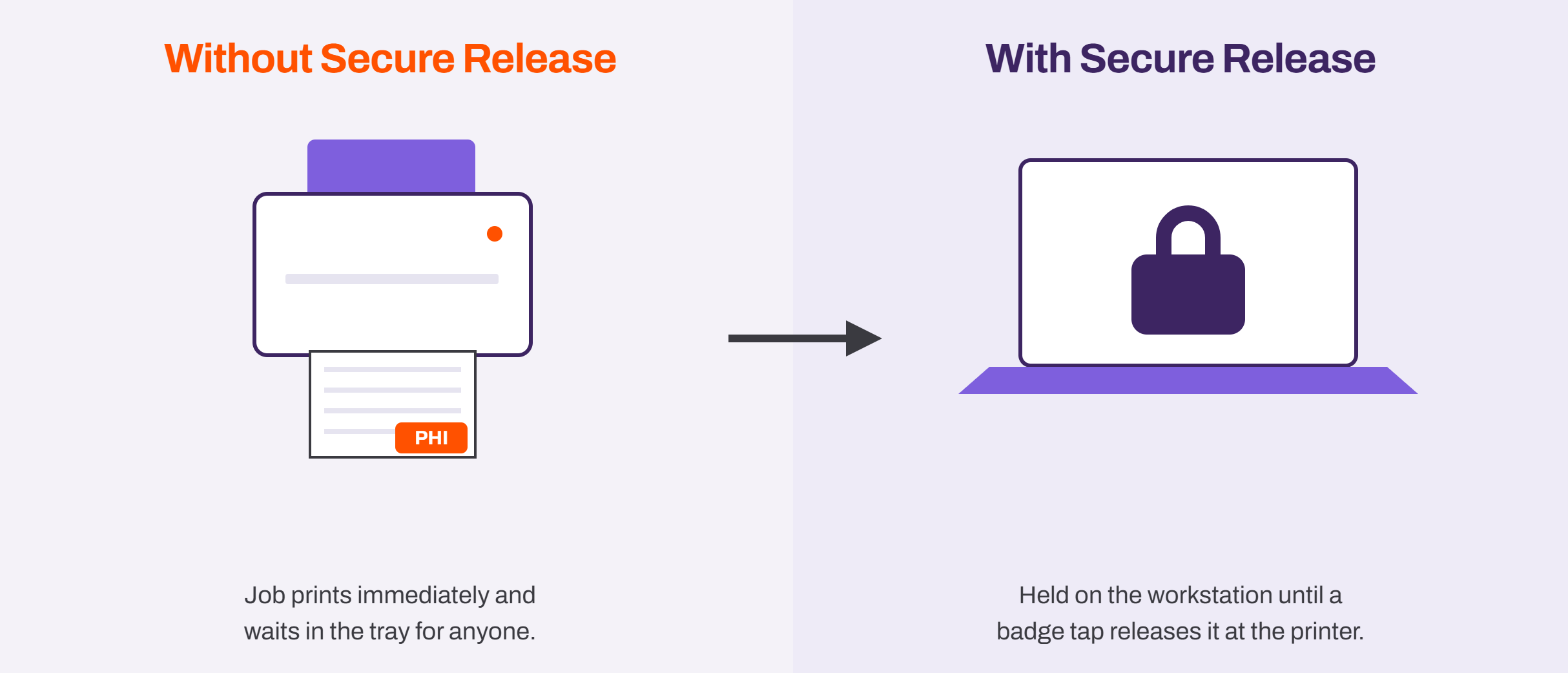
Imagine a nursing station on a busy floor. A clinician sends a face sheet to the shared printer, then gets pulled into a room before the page comes out. The document sits in the tray. For the next 20 minutes anyone who walks past, another patient, a family member, a delivery driver, a contractor, can read it or pick it up. No alert fires. No log records it. And every control you spent years building, the encryption, the identity provider, the audit trail on the EHR, stops at the edge of that tray.
This is one of the most overlooked parts of the security model, and it is the one a HIPAA auditor can see with their own eyes. My case here is simple: the abandoned printout is one of the most common physical PHI exposures, and among the most preventable. Secure Release Printing is the control that closes it.
The Tray Is Where Your Controls End
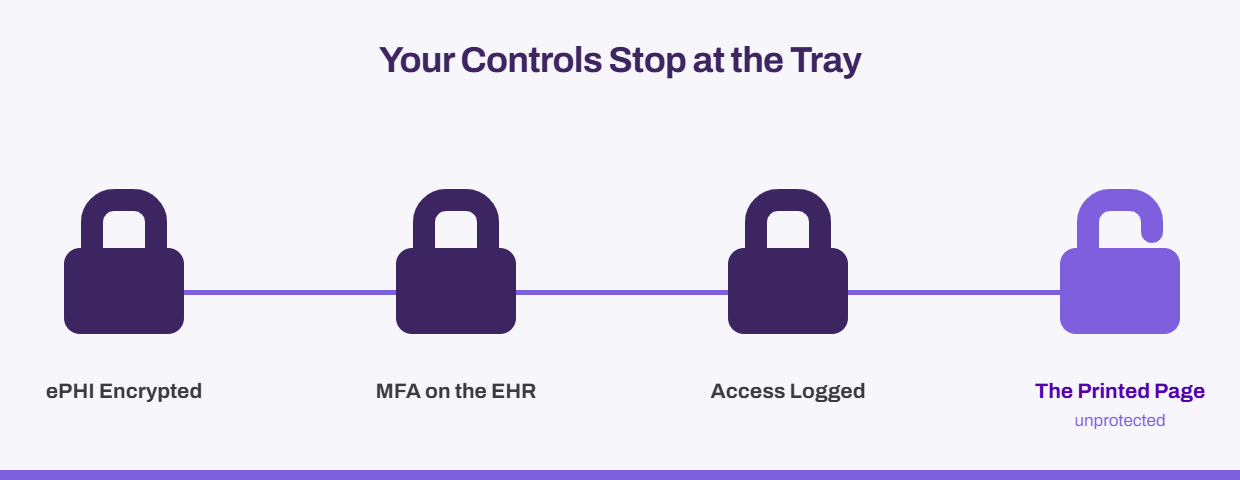
Healthcare has spent a decade hardening its systems. Electronic protected health information (ePHI) is encrypted in transit and at rest, the EHR sits behind multi-factor authentication, and every record access is logged. Then someone hits Print, and the document leaves all of it. The moment a page reaches an unattended tray, it is outside identity, outside encryption, and outside any record of who saw it.
The scale of the problem is not anecdotal. In Quocirca's Print Security Landscape, 2026 study, 67 percent of organizations reported at least one print-related data loss in the past year, up from 56 percent a year earlier (Quocirca Print Security Landscape, 2026). In a clinical corridor, an abandoned discharge summary or medication list is not a near miss. It is an impermissible disclosure of PHI, and it is the kind that is invisible after the fact. When compliance asks who viewed a document, a legacy print environment has no answer, because it never watched the tray in the first place.
What Secure Release Printing Does
Secure Release Printing changes the sequence. When a user sends a job, nothing prints. The job is held in a protected queue on the user's workstation, one only that user can release by authenticating at a printer and collecting it. The physical page only ever exists while the authorized person is standing at the device to collect it. There is no window during which a document waits in a tray for someone else to find.
Because the release is deliberate, the jobs people send by mistake, the duplicate, the wrong printer, the report they no longer need, never reach paper at all. Exposure and waste drop together, which is why the same feature that satisfies a compliance officer also shows up in the sustainability numbers.
Just as important, it meets clinicians where they already work. A held job can be released several ways: a badge tap at the device, a PIN, an identity-provider login at the control panel, the PrinterLogic mobile app or a QR code, or a web browser. Which of those an organization turns on is a configuration choice, so a hospital can standardize on the badge and hold the rest in reserve.
Badge Tap Is What Makes It Stick
Secure print is not a new idea, and that is exactly why the objection is worth taking seriously: many attempts fail on adoption. Add a few seconds and an extra step to every print job and clinicians will route around it. The feature that is not used protects nothing.
This is where an Imprivata integration matters, especially on the shared clinical workstations (Imprivata's 'Type 2') that fill hospital floors. Clinicians already tap their badge for single sign-on to those workstations. A shared kiosk creates an attribution problem: the Windows session runs under a generic account, so a print job would ordinarily belong to the computer rather than to the clinician who sent it. Vasion, now an Imprivata-Ready Certified technology integrator, resolves the badge-authenticated user from Imprivata Enterprise Access Management (EAM) and tags the job with that identity. Imprivata does not release the job itself; it provides the trusted badge identity. PrinterLogic Secure Release uses that identity, so a tap at the multifunction printer releases the clinician's held jobs, and standard assigned workstations (Imprivata's 'Type 1') behave the same way. No new credential, no new habit, no password to re-enter at the device. The security control rides on a motion staff already make dozens of times a shift.
It also fits how care flows. A clinician can send a job from any shared workstation, walk to whichever printer on the unit is free, and tap to release it there, rather than being tied to one device. Offline Secure Release lets them start a job and still collect it after the laptop sleeps or the virtual session closes, which is the reality of roaming staff and VDI. Delegated Release covers the team-based reality of a care unit: a clinician can assign a held job to an approved colleague, so a nurse releases a physician's document without shared logins or a borrowed badge, and the audit trail still names who released it. And for federal and VA settings, the same badge readers support CAC and PIV credentials, so the release step aligns with the authentication standard those environments already require.
The Byproduct: An Audit Trail You Did Not Have
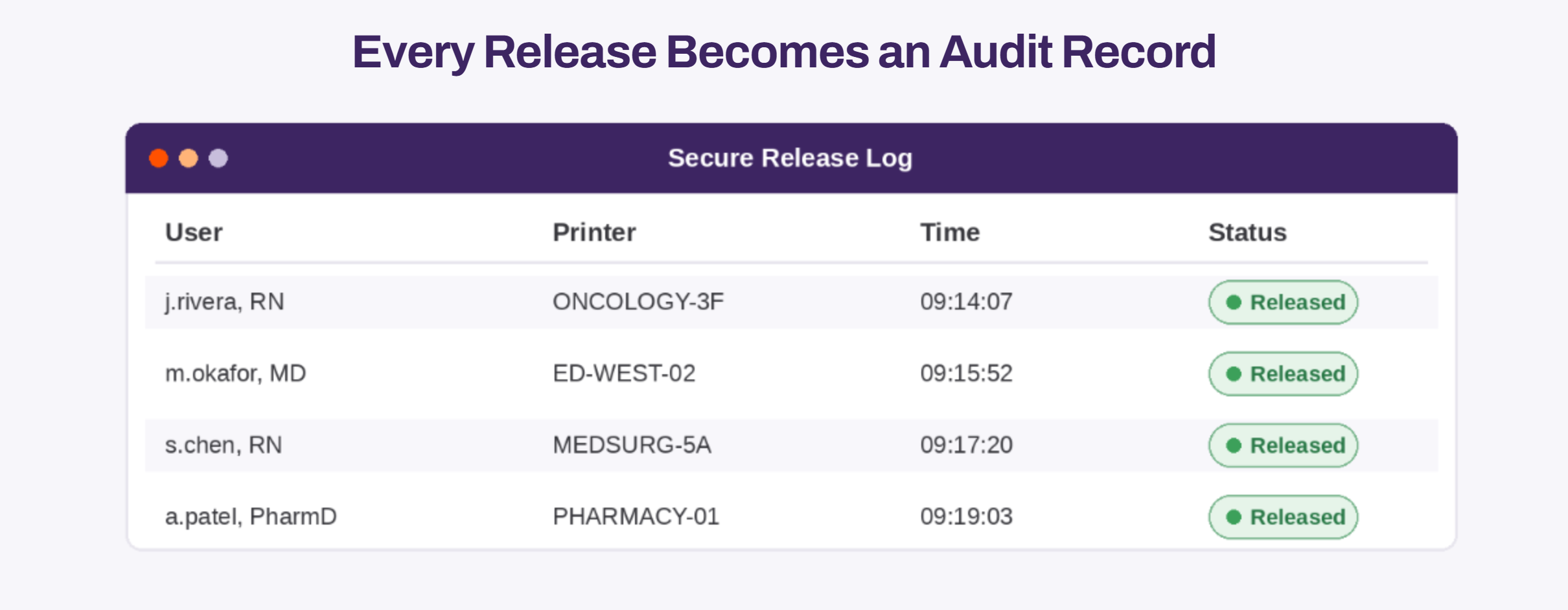
Because release is now an authenticated event, every printed document produces a record: who released it, at which printer, and when. That is precisely the artifact a HIPAA auditor or a cyber insurer asks for, and it is the one a rack of print servers could not produce, because nothing there ties a person to the moment a page was released. The physical output of the EHR finally has the same accountability as the record inside it.
It also sits inside the right architecture. PrinterLogic holds and releases jobs over a serverless, direct IP model, so print traffic stays local and users authenticate through Entra ID, Okta, or Google Identity under a Zero Trust approach. There is no shared print-server spooler in the path, which removes both a class of attack and the single point of failure that used to stand between a clinician and a printer. In the same Quocirca study, 84 percent of IT decision makers rated integrating identity platforms with print infrastructure as extremely or very important, up from 74 percent a year earlier.
Rolling It Out Without Touching Clinical Workflow
The reasonable worry is disruption in a 24/7 environment, and Secure Release Printing is built to avoid it. It is part of the Advanced Security Add-on (ASA) on PrinterLogic and layers onto the serverless direct IP platform, so it does not require replacing printers; it works across universal printer brands, through an on-device control panel app or the mobile app. You can turn it on by unit or by floor, prove it on a single ward, and expand at the pace the clinical staff can absorb. Nothing about the way a clinician prints will change except the one thing that was always the risk.
The Bottom Line
The systems have been secured for years. The tray is what is left. An unclaimed printout is the most literal form of a PHI exposure, it happens routinely, and it is entirely preventable. Secure Release Printing closes that gap by making sure a document exists on paper only when the right person is there to take it, and the Imprivata badge tap is what makes clinicians use it rather than work around it.
If you want to see it against your own floor plan, explore Vasion in healthcare and schedule a demo.