
Off-Network Printing for Rural Clinics, Home Health, and Telehealth


Victor Grund, VP Solutions Engineering, Vasion
July 27, 2026
7 mins
Healthcare has moved to the edge. Care no longer happens only inside a hospital with a rack of print servers down the hall. It also happens in a rural clinic or satellite office that is two hours from the nearest data center, in a patient's living room during a home health visit, and on a tablet during a telehealth encounter. The clinical work followed the patient. For the most part, printing did not, because the traditional model assumes the device and the printer can see each other on the same network. At the edge, they cannot. This is the problem Off-Network Printing is built to solve.
The Edge Is Where Care Is Moving Now
The shift is not anecdotal. According to The Chartis Center for Rural Health, more than 40% of rural hospitals now operate at a loss, 417 are vulnerable to closure, and 200 have closed or dropped inpatient care since 2010. As those facilities contract, care disperses into satellite clinics, Rural Emergency Hospitals, and community sites that serve the more than 46 million people who live in rural America. These sites rarely have IT staff on the ground, and almost never have a print server.
Home-based care is expanding on the same curve. The Centers for Disease Control and Prevention counts roughly 11,500 home health agencies in the United States, with 3.3 million patients receiving and completing care in 2022 alone. Telehealth settled in as permanent infrastructure rather than a pandemic stopgap: in 2021 (the last year for which data is available), 37% of U.S. adults reported a telemedicine visit in the prior 12 months, rising to 43 percent among adults 65 and older, the group most likely to need a printed medication list, a care-plan summary, or a signed consent form left behind in the home. 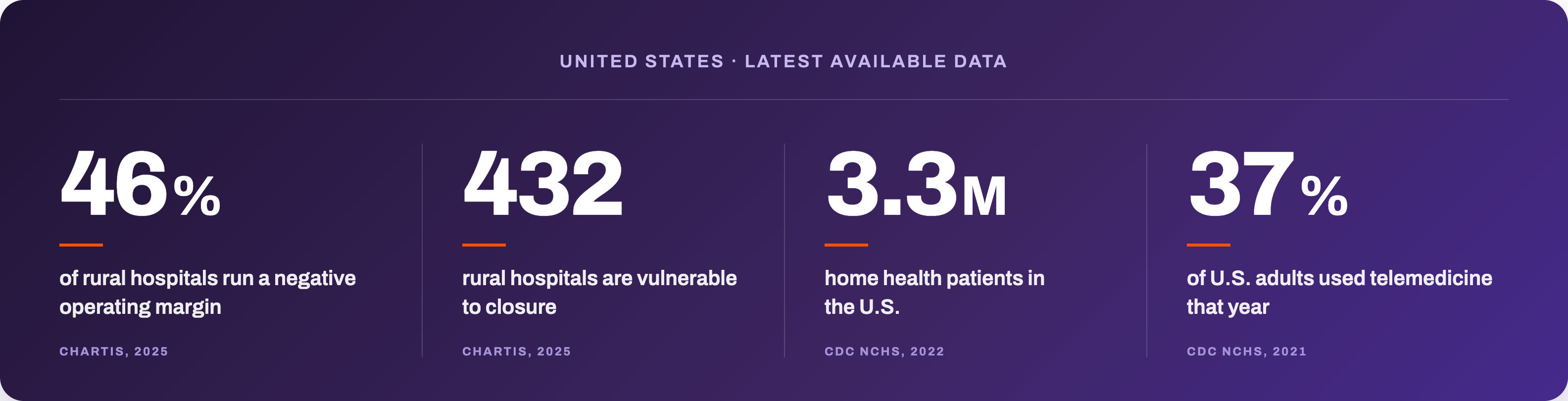
The figures here are from the United States, where the reporting is richest, but the shift is not unique to it. Health systems in many countries are moving care into smaller satellite sites, community clinics, and patients' homes. Every one of those distributed encounters still generates paper at some point, whether a wristband, a lab label, a discharge instruction, a consent form, or an after-visit summary. The care model changed but the requirement to produce a trusted, auditable printed document did not.
Why the Edge Breaks Traditional Printing
Conventional network printing assumes line-of-sight: the workstation and the printer sit on the same LAN, or a print server bridges them. That assumption collapses the moment a clinician is on a home Wi-Fi network, a clinic's consumer-grade internet, or a cellular tablet. The printer they need to reach sits behind a firewall somewhere else entirely, and there is no direct path to it.
The usual workarounds each carry a tax. A VPN extends the corporate network to every remote site, which means more tunnels to license, patch, and troubleshoot, and a larger attack surface for an industry that can least afford one. A web print portal forces clinicians to upload documents to a third party, an awkward fit for protected health information. Shipping a local printer to every home health nurse creates an unmanaged, unaudited endpoint in someone's spare room. And standing up a print server at each satellite clinic simply recreates, in miniature and multiplied, the fragile infrastructure most health systems are trying to eliminate.
The edge needs printing that does not depend on the network topology at all. It needs a document to travel securely from wherever the clinician is to whichever printer is authorized to produce it, without a tunnel, without a portal, and without exposing the printer to the internet.
How Off-Network Printing Works
Off-Network Printing, part of PrinterLogic on the Vasion Platform, decouples the print job from the network entirely. When a clinician prints from a distributed site, the job is encrypted on the device and sent over an ordinary internet connection to a Vasion-hosted External Gateway. That gateway is one of Vasion's regional gateways, run across the Americas, EMEA, and Asia Pacific, so an edge site connects to nearby infrastructure wherever it operates. The gateway holds the job only briefly, encrypted in transit and at rest, and deletes it once it prints; it never opens a connection into your environment.
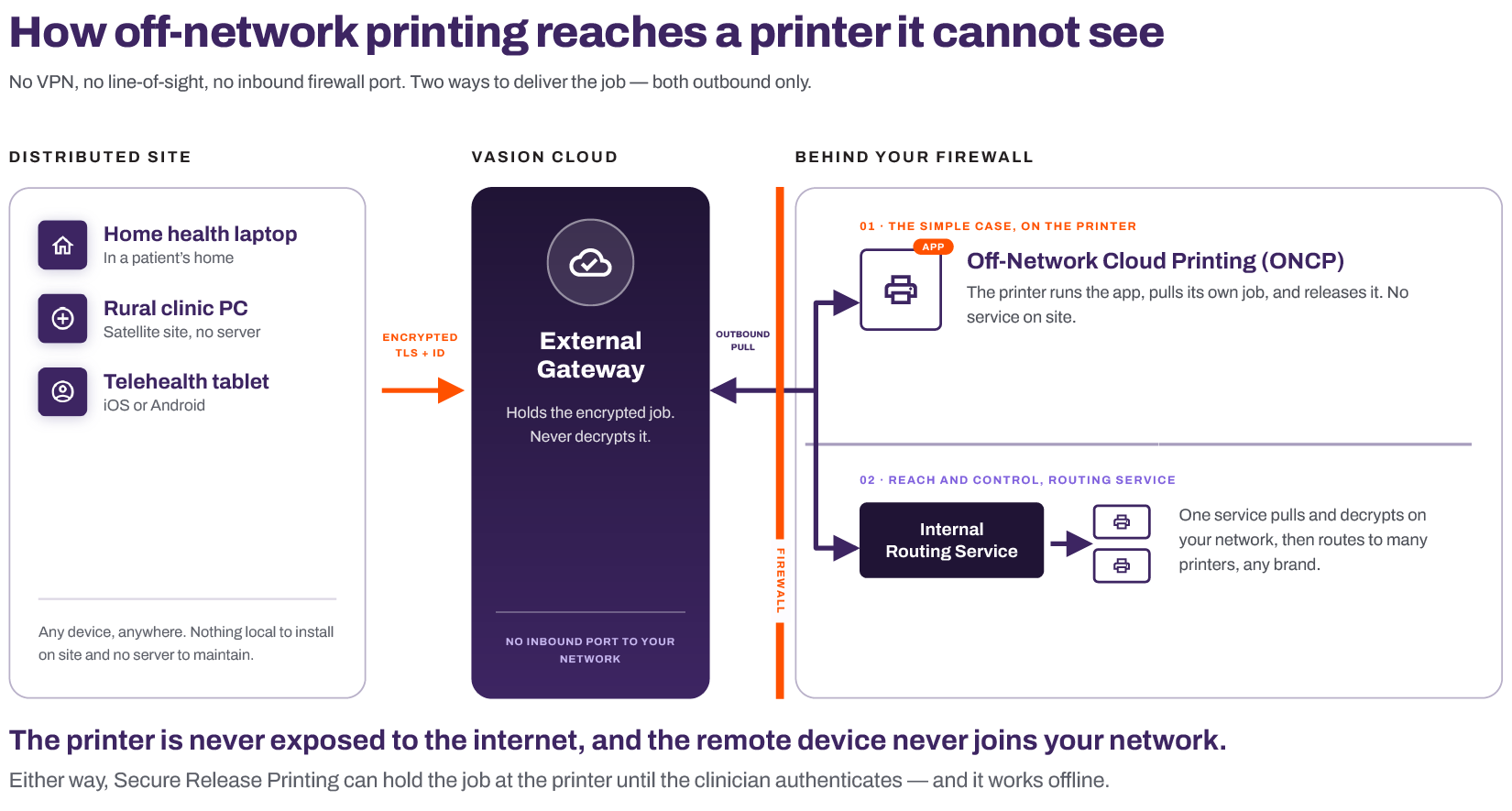
Behind your firewall, the job can reach the printer two ways, and both keep the same security property: the connection out to the gateway is outbound only, so no inbound port is ever opened, the printer is never exposed to the internet, and the remote device never joins your network. It is a Zero Trust pattern applied to print, where identity travels with the job and nothing is trusted by virtue of its location. The simplest option is Off-Network Cloud Printing (ONCP), which runs a lightweight app on the printer itself on supported devices. The printer watches the gateway, pulls its own jobs, and releases them, so an edge site can run on little more than a printer and an internet connection, with no server and nothing extra for local staff to manage. For a small or unstaffed location, that simplicity is often reason enough on its own.
The other option is a lightweight Internal Routing Service, a small service you run behind the firewall. It keeps a constant outbound connection to the gateway, a WebSocket on port 443, and holds it open to watch for jobs; when one arrives, it pulls the job down over an encrypted connection and hands it to the target printer over the standard print port. Sites choose it for reach and control: one routing service can serve many printers at once, cover brands that cannot run the on-device app, and give a larger or mixed fleet centralized, redundant routing. Administrators tune this through Off-Network Priority, which decides whether the agent tries direct IP delivery first and falls back to the cloud service, or routes through the service exclusively. The service agent is printer-agnostic, so a mixed or older fleet can standardize on it. Off-Network Printing runs on PrinterLogic SaaS and Virtual Appliance, and prints directly from iOS and Android without any client software on the device, which matters when the endpoint is a clinician's tablet rather than a managed laptop.
What This Looks Like in the Field
At a rural clinic operating as a spoke of a larger system, staff print to the printer in front of them, but the routing, drivers, and security policy are managed centrally from the cloud. There is no server to fail on a Saturday with no technician within 90 minutes.
For a home health nurse, the after-visit summary, the updated medication list, or the consent form prints to a designated printer back at the branch office, ready for the chart, without a printer in the patient's home and without emailing protected health information through a personal account. The job is held securely until it is released by an authorized person at the device.
In a telehealth workflow, the same path lets a clinician generate a printed order, a referral, or discharge instructions to a printer at the receiving site during or immediately after the encounter, closing the loop between a virtual visit and the physical document on which the next step in care depends.
Security and Compliance Travel With the Job
Distributed printing usually widens the compliance gap. Off-Network Printing narrows it. Jobs are encrypted in transit and decrypted only inside your firewall, so protected health information is never sitting in clear text on a third-party service. Secure Release Printing, including Offline Secure Release, holds the job until the intended recipient authenticates at the printer with a badge, a touchless smartphone release, or credentials, so a discharge summary is not sitting in an output tray at an unstaffed clinic. Because the release is tied to identity, every job produces a record of who printed what, where, and when, which is exactly the artifact a compliance reviewer or a cyber insurer will request, whether the standard is HIPAA, GDPR, or another regional health-data regime.
The same model extends to system-generated output. The Advanced Security Add-on pairs Secure Release with Off-Network Printing, and those controls extend to back-end electronic health record (EHR) and enterprise resource planning (ERP) output through PrinterLogic Output, so the wristbands, lab labels, and order documents a distributed site requires travel under the same Zero Trust, fully audited controls as end-user print.
Spring 2026: Driverless at the Edge
The Spring 2026 release makes the edge case even cleaner in two distinct ways. First, the PrinterLogic direct IP model now runs fully driverless, with native IPP and IPPS support across Windows, Mac, and Linux, so Microsoft's move away from third-party print drivers becomes a non-event for distributed sites. Second, the advanced off-network features now reach Windows ARM devices, the lightweight, cellular-friendly hardware that suits a home health or telehealth fleet. That covers both delivery models described earlier, the on-printer ONCP app and the Internal Routing Service, along with Offline Secure Release. Driverless printing and off-network delivery are separate advances: the first removes the print driver from the endpoint, and the second governs how a job reaches a printer behind your firewall.
On the output side, the new API Cloud Link for Epic routes EHR-generated documents without a VPN or an on-premise footprint, delivers them through Off-Network Printing, and confirms delivery back to Epic automatically, with a step-by-step job history in the Output Console showing where each job was received, how it was routed, and where it landed. For a satellite site, that means EHR output arrives reliably and provably, with no local server and no line-of-sight to the source system.
Start Where the Network Ends
Care has already moved to the edge. The printed documents that care depends on must follow it, without dragging along the servers, tunnels, and portals that made print fragile in the first place. Off-Network Printing lets a rural clinic, a home health nurse, or a telehealth clinician reach the right printer securely, from any connection, with the job encrypted end to end and audited from click to tray, and with nothing exposed that should not be.
If your care sites have outrun your print architecture, that gap is worth closing before an auditor or an outage finds it first. Explore Vasion in healthcare and request a demo.